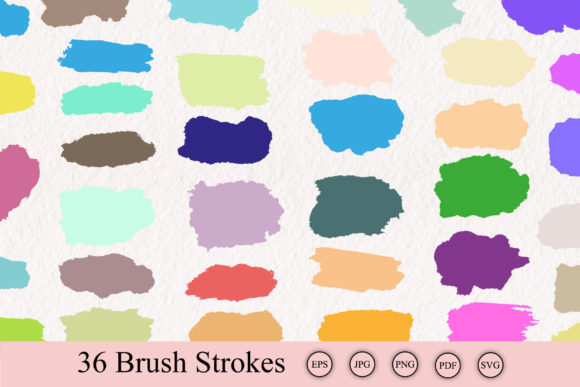
Colorful Brush Strokes Bundle
First Impressions: Loose, Lively, and Unapologetically Handmade
Opening the Colorful Brush Strokes Bundle feels like flipping through a designer’s private sketchbook—inky, expressive, and full of intentional imperfection. These aren’t rigid vector shapes or sterile clipart; they’re hand-printed texture elements that carry weight, gesture, and rhythm. The black brush strokes vary in thickness, taper, and energy—some sharp and decisive, others soft-edged and fading. As a designer who regularly translates digital assets into machine embroidery, I immediately ask: *How will this move under needle? How will it hold up on fabric—not screen?* My first real test was for a custom embroidered tote bag destined for a local ceramicist’s pop-up shop. She wanted “artistic but wearable,” something that felt human-made, not algorithm-generated. That’s exactly where Colorful Brush Strokes Bundle shines.
Where It Lives Best: Embroidery Projects with Personality
This bundle isn’t built for tiny monograms or crisp corporate logos. It thrives in projects where authenticity and tactile charm matter more than pixel-perfect symmetry. Think sweatshirt embroidery for indie bookstores, baby embroidery on organic cotton onesies (paired with subtle satin-stitch outlines), or holiday embroidery on linen tea towels where the brushwork echoes hand-painted ceramics or watercolor cards. I tested one stroke element as an embroidered patch on twill fabric—it stitched cleanly at 4.5" wide with medium-density fill stitch and a tear-away + cut-away stabilizer combo. The variation in line weight translated beautifully: thicker sections held rich thread coverage, while delicate tails softened naturally without fraying or skipped stitches. For Etsy sellers, this is gold—it adds instant visual distinction to listings, especially when paired with printable mockups showing the design on natural fabrics.
What Works Smoothly (and Why)
- Tote bag design: Large, open areas let the brushstrokes breathe—no crowding, no over-stitching fatigue.
- Sweatshirt embroidery: The bold black-on-cream contrast reads clearly even on textured fleece, especially when using matte polyester thread.
- Personalized gifts: A single expressive stroke beside a name (e.g., “Eli” + upward-sweeping stroke) feels intentional, not decorative filler.
- Boutique branding: Used as a subtle watermark or corner accent on packaging tags or fabric labels, it reinforces handmade credibility without shouting.
- Holiday embroidery: On velvet stockings or wool-blend blankets, the strokes mimic traditional hand-embroidered flourishes—warm, not clinical.
Where to Pause—and Test First
Not every surface welcomes expressive brushwork equally. On thin or stretchy fabric (like jersey tees or baby knit caps), fine tapered ends can blur or distort unless stabilized aggressively—and even then, I’d avoid placing strokes directly over seams or curved zones like crown areas of caps. Dark fabric demands careful thread color review: pure black thread on charcoal fabric can vanish, so testing with charcoal-gray or deep navy thread often reads truer. Also, don’t assume all 36 elements scale identically—some include tighter loops or intersecting lines that increase stitch density unexpectedly. Always inspect small details in your embroidery software before hooping. And yes—run a test on scrap fabric first. Not just once, but twice: once with your preferred stabilizer, once with your intended thread colors. What looks vibrant on-screen may mute under needle.
Design Integrity in Real-World Use
Customers notice authenticity. When a client sees that a custom apron doesn’t just say “Bake Joy”—but features a fluid, confident brushstroke beside it—they subconsciously register care, craft, and intention. That lifts perceived value. For craft business owners, that means higher pricing confidence and fewer “Is this printed?” questions. For Etsy sellers, it boosts engagement: shoppers linger longer on listings where design assets feel curated, not cobbled together. But here’s the quiet truth—Colorful Brush Strokes Bundle only delivers that impact if used thoughtfully. Slapping it onto a busy background print or shrinking it too small for a keychain patch sacrifices its strength: gesture. Its power lies in breathing room, contrast, and context.
Practical Notes Every Embroidery Designer Should Keep Handy
- Check licensing before using in commercial embroidery or selling finished products—especially if bundling with other graphics or offering as part of a digital embroidery file pack.
- Confirm hoop size compatibility: larger strokes may require 6" x 10" or bigger hoops; smaller ones work in 4" rounds—but verify each file individually.
- Test both light and dark fabric backgrounds using simple black-and-white mockups—this reveals how much detail survives translation to thread.
- Use proper stabilizer: lightweight cut-away for stable wovens, mesh cut-away for knits, and always match thread weight to fabric drape.
- Review stitch density in your editing software—dense fill areas in curved strokes may pucker thin fabrics unless reduced slightly.
- Ask yourself: does this enhance the product—or distract from its function? A brushstroke on a kitchen towel should invite touch, not compete with utility.
Final Thought: A Tool That Rewards Intention
Colorful Brush Strokes Bundle isn’t a shortcut. It’s a collaborator. It asks you to slow down—to consider fabric grain, thread sheen, customer expectation, and the quiet language of handmade presentation. When used well—as a bold accent on a linen pillow cover, a rhythmic pulse beside hand-lettered baby embroidery, or the unifying graphic thread across a small shop’s seasonal collection—it doesn’t just decorate. It connects. That’s what makes it valuable not just as Graphics, but as Decorative Elements with staying power. Whether you’re stitching for joy, clients, or commerce, this bundle reminds you: sometimes the most professional thing you can do is leave space for the hand to show through.